
1.5M+
Emergency visits for harm from medicines, every year
Nearly 500,000 of them end in a hospital stay.
CDC Medication Safety Program, FastStats (2024)Warns · Answers
Talking caps for the pharmacy bottles people already have, with Mavis, a voice you can simply talk to. Ask what the medication is, what it's for, and when you last opened it. If two medicines shouldn't be taken close together, the cap warns you before the mistake.
In development · prototype stage · not yet for sale
Sources: CDC Medication Safety (2024) · America's Poison Centers NPDS 2024 · CDC NCHS, Health, United States (2017–20) · Qato et al., JAMA Intern Med 2016 (2010–11 data)
A concept demonstration of the design model: what Mavis says, what it remembers, and how it warns before a mix-up.
Concept demonstration. Product shots are renders of the design model, not final hardware. The voices are synthetic, and prices are planned. Photo credits are on the video's closing card.
Mavis MedBase is at the prototype stage. Join the waitlist to hear first when the Kickstarter goes live and when home pilots open.
Joining is free.
No reloading pills into a machine. The caps go on standard pharmacy vials, and each one works on its own, even with no phone nearby.
If two of your medicines shouldn't be taken close together, the cap you just opened lights up and says so, using the timing on the FDA labels.
Each cap keeps its own record of when the bottle was opened, so "did I already take it?" has an answer, and a caregiver can see it too.
Talk to Mavis through the cap: ask what it is, what it's for, or when you last opened it. It's a two-way, full-duplex conversation, so you can interrupt or follow up the way you would with a person.
YouWhat is this?
MavisThis is lisinopril, 10 milligrams. It's for blood pressure. The label says take one tablet each morning.
YouWhen did I last take it?
MavisYou last opened this bottle today at 8:02 a.m.
You(opens the levothyroxine bottle)
MavisWait. You opened your calcium carbonate 40 minutes ago. The Synthroid label says to take it at least 4 hours apart from calcium carbonate. Check with your pharmacist.
Adverse drug events are harmful reactions to a medicine: a double dose, the wrong bottle, two drugs that shouldn't meet. These are the numbers Mavis MedBase is built against.
Nearly 500,000 of them end in a hospital stay.
12.1 vs 5.0 visits per 1,000 people a year, and nearly half of visits by people 75+ end in admission. Blood thinners and diabetes medicines lead the list.
The most common home medication mistake in 2024, two-thirds of them in adults. Another 52,634 people took the wrong medicine and 40,996 took doses too close together.
Admissions for medication errors outside health-care settings nearly tripled per million people; 96% happened at home, and rates were highest in people over 69.
15.1% of adults 62–85, nearly double the share five years earlier.
Among patients with low literacy, 71% could read the instruction but only 35% could demonstrate it correctly.
About 7 million Americans have vision impairment, including 1 million who are blind.
Of 63 million U.S. family caregivers, more than half do medical and nursing tasks. Only 22% were trained for it.
Figures are quoted from the linked sources, with the year of the data. Poison-center counts include only cases that were reported, so they undercount.
Three groups Mavis MedBase is designed with in mind, and the numbers behind them.

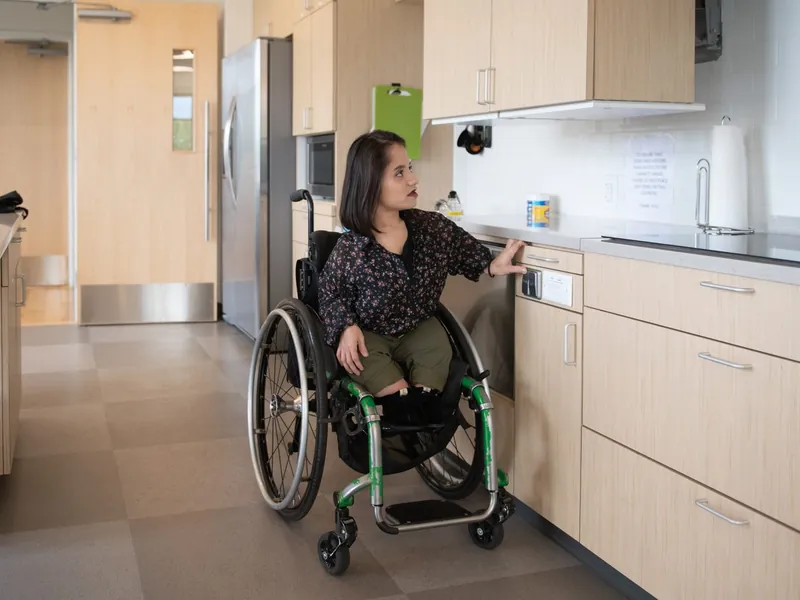








Photos, left to right: Centre for Ageing Better (public domain) · Chona Kasinger, Disabled And Here (CC BY 4.0) · Centre for Ageing Better (public domain) · Gritchelle Fallesgon, Disabled And Here (CC BY 4.0) · Towfiqu barbhuiya (Unsplash License) · Gritchelle Fallesgon, Disabled And Here (CC BY 4.0) · Gritchelle Fallesgon, Disabled And Here (CC BY 4.0) · Centre for Ageing Better (public domain) · Centre for Ageing Better (public domain) · Mel Elías (CC0).
Small print, stiff caps and memory loss make every bottle harder to manage.
U.S. adults have a disability: more than 1 in 4, and 44% of adults 65 and older.
Americans 65 and older live with Alzheimer's. People living with dementia rely on an average of 2.5 caregivers to manage their medicines.
The ages of the adults who test child-resistant caps. People over 70 and people with disabilities aren't on the panel. Anyone can ask the pharmacy for an easy-open cap.
How Mavis helps. Voice first, with raised tiles to find by touch. Ask Mavis to repeat anything, and caregivers can share the log.
Missed and doubled doses matter more with these medicines, and some combinations carry FDA’s strongest warnings.
U.S. adults took prescription medicine for their mental health in 2025, 16% of all adults.
People with schizophrenia don't take antipsychotics as prescribed. In trials, 64% relapsed within a year without medication, against 27% with it.
Opioid and benzodiazepine products carry FDA's strongest warning against taking them together. Some pain and migraine medicines can cause serotonin syndrome with antidepressants.
How Mavis helps. “Did I already take it?” gets an answer from the last time the bottle was opened, so nobody doubles a dose by guessing. Warnings come from FDA labels.
If you or someone you know is in crisis, call or text 988 (Suicide & Crisis Lifeline). In an emergency, call 911.
Pets take medicines too, and FDA warns that pet and people medicines get mixed up.
U.S. households have a pet: 71 million have a dog and 53 million a cat.
Pet poison is over-the-counter medicine and supplements, 16.9% of cases. Human prescription medicines rank third.
Of doses were given on time when dog owners’ pill bottles had monitoring caps, though the owners reported giving every dose (90 dogs, Canada).
How Mavis helps. A cap on the pet’s bottle shows the household when it was last opened, so the dog doesn’t get a second dose. FDA advises keeping pet and people medicines apart.
Figures are quoted from the linked sources, with the year of the data. The groups overlap. Trial results are not the same as everyday rates.
The charging base and three talking caps, in three dimensions. Drag to rotate all the way around, straight down onto the caps, or up under the base, or jump to a view.
The cap works on its own. The phone app, the web app and the Charging Base each add more, and none of them is required.
Caps + the free Mavis app on iPhone or Android. Reminders, warnings and caregiver sharing through the phone.
The Charging Base plugs in at home and connects the caps to the family app over Wi-Fi, 24 hours a day.
A cellular Charging Base connects on its own, with nothing to set up.
Every cap still reminds, remembers and warns on its own, and answers from its button.
The talking cap reads the label out loud, found by touch with raised-dot tiles.
Caregivers see doses and get missed-dose alerts in the web app, on any device.
Pill dispensers run $30–125 a month, and medical-alert plans $25–45. Mavis MedBase starts with caps you own and a free app.
Talk with Mavis through the cap, two ways at once. Ask what it is, what it's for, or when you last opened it. Rechargeable.
Remembers every opening and warns with a light and a tone. A coin battery lasts about a year.
Charges the talking caps overnight and connects them to the family app for homes without a smartphone.
Everything to start: three talking caps and the Charging Base.
Reminders, the last-opened log, interaction warnings and the cap's own answers. Safety features are never behind a paywall.
Open-ended conversations with Mavis, refill predictions and reports to share with your doctor. $39.99 a year.
Plus, for up to three caregivers, with missed-dose alerts.
Family, plus the Charging Base and three talking caps for $49 upfront, for a home without a smartphone. 12-month plan.
A cellular Charging Base, three talking caps and the data, with nothing upfront, for a home without Wi-Fi. 12-month plan.
A reusable talking cap, programmed at the counter. No setup fee and no reader to lend.
Loaned caps and bases, app, caregiver alerts and reporting. $12 for PACE and for plans with 5,000+ members.
App and caps for CMS ACCESS programs; a $25 monthly reminder service for Medicaid home and community programs.
Sponsored access. Metis Foundry is applying for government grants and program funding to sponsor Mavis MedBase for people who can't afford it, including older adults, veterans and people with vision loss.
Target launch prices, set against costs and competitor prices checked in September 2026. They may change before launch.
For people who can't read small print, including people who are blind, have low vision or have trouble reading, the talking cap has three raised tiles you can find by touch. Each one asks Mavis a question, or just talk to it.
What is this, and what is it for?
How do I take it, and what shouldn't I take it with?
When did I last take it?
A "read the whole label" mode is designed to speak the pharmacy label word for word, in the order it is printed, as checked by the pharmacist.
An assistant that talks about medication has to know what it must not say. These are design commitments, built into Mavis from the start.
Three cap sizes drawn in CAD, with tactile tiles.
Electronics and behaviour specified: voice, lights, opening sensor.
The AI medication assistant, first as a phone app prototype.
Caps and base, part by part, with dimensioned drawings in 2026.
Talking caps, a web and phone app, and the Charging Base. Pilot planning.
We're looking for health plans, PACE programs, pharmacies, senior-living communities and researchers to pilot Mavis MedBase with older adults and their caregivers.
hello@metisfoundry.com